
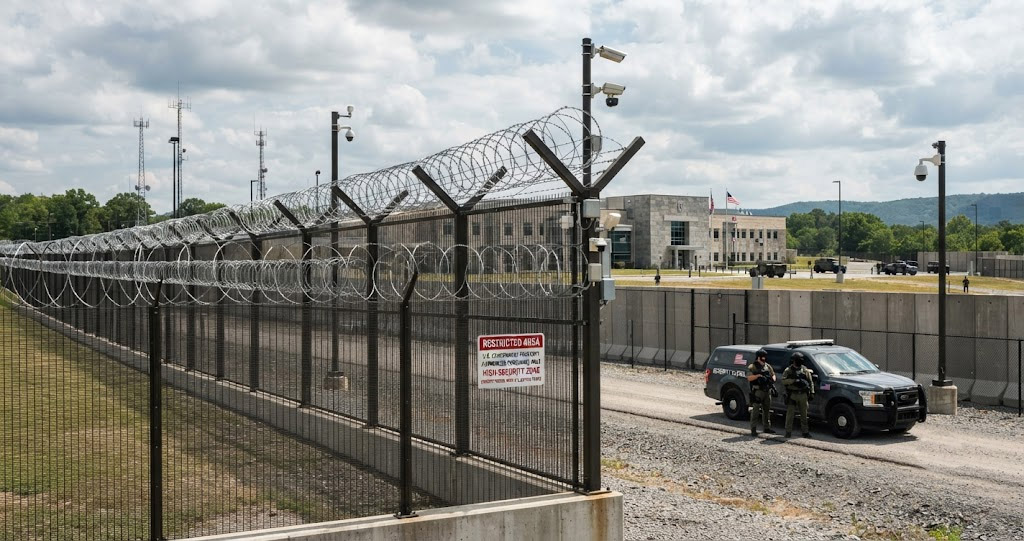
High-Security Perimeter Fencing for Government and Military Installations
A breach at a government or defence facility isn't measured in property loss, it's measured in national risk. That's why high-security perimeter fencing for these sites is engineered to a completely different standard than commercial or residential boundary walls. As a leading manufacturer of perimeter security fencing systems with over 15 years supplying government, defence, and critical infrastructure projects across India, we've put together this guide for procurement officers, facility managers, and security consultants specifying fencing that has to hold under real-world threat conditions, not just pass a paper spec.
Why Government and Military Sites Need a Different Fencing Standard
Government facility security fencing is specified against threat models that commercial fencing never has to consider, coordinated forced entry, tool-assisted cutting attempts, and sustained climbing attacks. A standard chain link boundary might deter casual trespassing, but it offers almost no resistance to a determined intruder with basic tools. This is the foundation of any high-security perimeter fencing strategy for critical facilities: assume the threat is capable, and design the barrier to slow it down at every layer.
Defence facility perimeter fencing in India typically follows a layered approach: a rigid, anti-climb primary barrier, a raised deterrent layer such as concertina wire, and in higher-risk zones, an electronic detection or electric shock layer. Each layer is designed to buy response time, since the objective isn't just to stop entry outright, it's to delay it long enough for security personnel to intervene.
Anti-Climb 358 Mesh: The Backbone of Government Site Security
Anti-climb 358 mesh government sites rely on has a small aperture, roughly 76mm x 12.7mm, and a rigid welded construction that leaves almost no foothold or handhold for climbing. The tight weld pattern also resists bolt cutters far better than standard chain link, since each wire intersection is welded rather than simply interlocked.
Our welded wire mesh systems are manufactured from Grade 350 high-tensile steel with hot-dip galvanizing up to 275g/m² zinc density, giving the mesh both the rigidity needed for anti-climb performance and the corrosion resistance required for exposed perimeter installations that need to perform for 20+ years with minimal maintenance.
Concertina Razor Wire for Military Installations
Concertina razor wire military installations deploy as a raised deterrent layer sits above or in front of the primary mesh barrier, and it remains one of the most effective visual and physical deterrents available. The expanding coil design and razor-sharp blade profile make it extremely difficult to cross without specialized cutting tools, and its visibility alone discourages casual intrusion attempts before they start.
Our concertina razor wire fencing is manufactured with high-tensile core wire that holds coil tension over years of outdoor exposure, a common failure point in lower-grade systems that loosen and lose their deterrent shape within a few seasons.
High-Security Fencing for Border Areas and Restricted Zones
A high-security fence for border areas has to perform in conditions most commercial fencing never faces, extended unmanned stretches, extreme weather exposure, and a genuine risk of coordinated breach attempts rather than opportunistic trespassing. Anti-intrusion fencing for restricted areas typically combines:
● A rigid anti-climb mesh or welded panel base layer
● Concertina or razor wire along the top and, in high-risk zones, the base
● Adequate post spacing and foundation depth to resist vehicle-ramming and sustained lateral force
● Corrosion protection suited to the specific terrain, coastal, desert, or high-humidity monsoon conditions
For sites needing a permanent physical barrier rather than a mesh-based system, an RCC compound wall is sometimes specified as the base layer, with anti-climb mesh or razor wire added on top for additional height and deterrence.
Military Perimeter Fencing Solutions Beyond the Base Layer
Military perimeter fencing solutions increasingly pair physical barriers with an active response layer. Electric fencing, when integrated along the same boundary as the mesh and razor wire, adds a deterrent shock and, depending on the system, an intrusion alert that flags attempted contact in real time.
Our electric fencing systems, sourced from internationally certified energizer brands, are commonly layered onto existing anti-climb mesh boundaries at defence and industrial sites where an active detection capability is required alongside the passive physical barrier.
Perimeter Security Fencing Standards in India
Perimeter security fencing standards that India-based government and defence procurement rely on typically draw from IS codes for wire tensile strength and steel grade, alongside project-specific specifications set by the commissioning authority. These standards form the backbone of any high-security perimeter fencing specification submitted for a government tender. Government installation fencing requirements generally cover:
1. Minimum yield and tensile strength for the primary mesh or wire (commonly Grade 350 or higher)
2. Zinc coating density for galvanized components, typically 200-275g/m² for long-term corrosion resistance
3. Mesh aperture size and wire gauge suited to the anti-climb and anti-cut requirement
4. Foundation and post-spacing calculations that account for wind load and impact resistance
5. Documentation, including mill test certificates, confirming compliance with the referenced material standard
Manufacturers operating under ISO 9001:2015 certified production, such as ours, supply this documentation as a standard part of the procurement package, which significantly shortens the technical verification cycle for government tenders and defence projects on tight timelines.
Choosing a Fencing Partner for Government and Defence Sites
Arihant Fence's experience delivering high-security perimeter fencing spans industrial parks, transit boundaries, and defence perimeters across Maharashtra and pan-India, giving us direct insight into what actually holds up under sustained field conditions rather than lab testing alone. For teams comparing barrier types before finalizing a specification, our guide on welded wire mesh specifications and grades offers useful groundwork for evaluating cost against long-term durability.
Frequently Asked Questions
What makes fencing suitable for government and military installations? It combines a rigid anti-climb mesh base layer, typically Grade 350 high-tensile steel, with a raised deterrent such as concertina razor wire, and often an active layer like electric fencing,
engineered to resist coordinated forced-entry attempts, the core requirement of any high-security perimeter fencing system.
What is anti-climb 358 mesh and why is it used at government sites? It's a welded mesh panel with a small 76mm x 12.7mm aperture that leaves no practical foothold or handhold, making it significantly harder to scale than standard chain link.
Is concertina razor wire still effective for military perimeter security? Yes. Its expanding coil and razor-blade profile remain one of the most effective physical and visual deterrents available, particularly when paired with a rigid mesh base layer.
What standards apply to perimeter security fencing for government projects in India? Requirements typically reference IS codes for wire tensile strength and steel grade, along with project-specific specifications from the commissioning authority covering coating density, mesh aperture, and foundation design.
Can electric fencing be added to an existing mesh perimeter at a defence site? Yes. Electric fencing is commonly retrofitted onto existing anti-climb mesh boundaries to add an active deterrent and detection layer without replacing the physical barrier.
Specifying high-security perimeter fencing for a government or defence installation? Arihant Fence is an ISO 9001:2015 certified manufacturer of anti-climb mesh, concertina razor wire, and electric fencing systems, serving government and military sites across Maharashtra and India.
📍 Arihant Steel, Agarwal Industrial Estate, Unit 1, Plot No.3, Sativali Kaman Road, Valiv, Vasai East, Palghar District, Maharashtra 401208, India 📞 +91 9322290173 | +91 8451902259 ✉️ arihantsteel123@gmail.com