
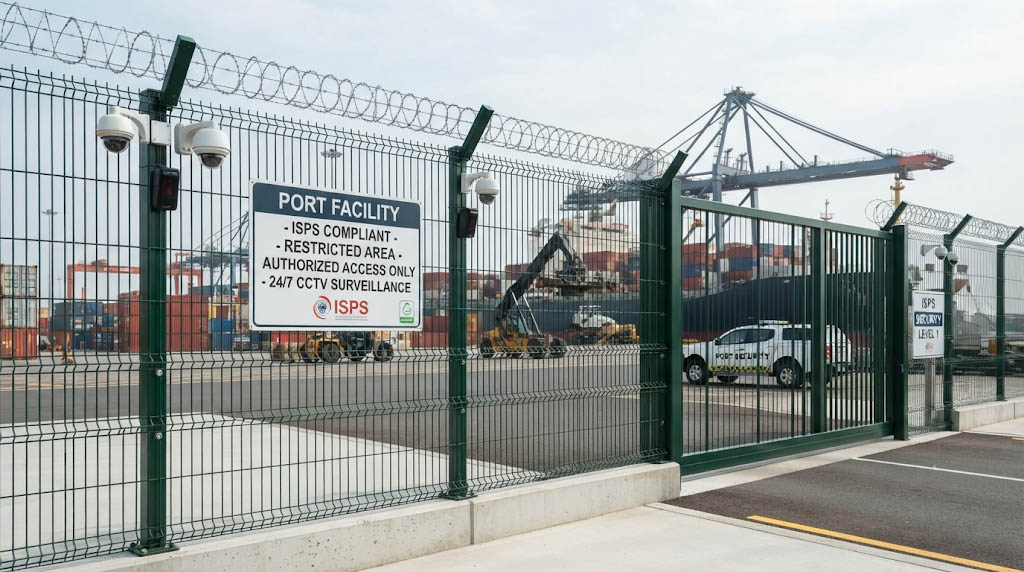
Port and Logistics Facility Fencing: Meeting ISPS Security Code
Requirements
Port and logistics facility fencing is the physical backbone
of ISPS Code compliance, since the International Ship and Port Facility
Security Code requires a clearly defined, monitored perimeter around every
regulated port facility. Getting this fencing right protects cargo, restricts
unauthorized access, and keeps a facility eligible to handle international
shipping without compliance penalties.
Why ISPS Compliance Starts With the Perimeter
The ISPS Code was adopted by the International Maritime
Organization as an amendment to the SOLAS Convention and came into force in
July 2004, following heightened global concern over maritime security. It
applies to port facilities that serve international voyages, requiring a
documented Port Facility Security Plan, restricted-area controls, and physical
barriers that prevent unauthorized entry.
Port authorities and terminal operators are audited against
these physical security measures, and perimeter fencing is typically the first
item inspectors check, since it defines where restricted areas legally begin.
Auditors generally expect ISPS compliant fencing to combine
height, anti-climb design, and monitored access points, not just a continuous
boundary line. A facility with strong internal security but a weak or damaged
perimeter fence can still fail an ISPS Code compliance requirements
review—which is why port and logistics facility fencing decisions are
increasingly made alongside the security plan itself, rather than treated as a
separate procurement item late in a project.
What ISPS Code Security Fencing Actually Requires
Unlike residential or commercial boundary fencing, port
perimeter security fencing must satisfy specific functional criteria tied
directly to the Code's three security levels (normal, heightened, and
exceptional threat). In practice, this means:
- Anti-climb
welded mesh fencing with height and mesh spacing sized to resist climbing
and cutting attempts
- Clear
zones on both sides of the fence line so patrols and CCTV have
unobstructed sightlines
- Restricted
area fencing that visibly separates public, operational, and high-security
zones
- Access
control fencing with integration points for lighting, cameras, and
logistics park perimeters
- Galvanized
steel fencing for corrosion resistance, since port environments expose
fencing to salt air, cargo handling equipment, and constant vehicle
movement
Container yard security fencing and warehouse and logistics
park fencing inside the same facility often need lighter specifications than
the outer ISPS perimeter, since internal zones are already behind the primary
security boundary. Separating these tiers correctly avoids over-engineering (and
over-spending on) sections that don't carry the same compliance weight as the
main perimeter.
This tiered approach also simplifies budgeting for large
sites. Instead of specifying uniform high-security fencing across an entire
logistics park, facility managers can direct spend toward the outer perimeter
security line while using more economical fencing for internal, already-secured
zones such as staff parking or administrative blocks.
Fencing Types Used in Port and Terminal Security
Facilities working toward or maintaining ISPS Code
compliance requirements typically choose from a small set of proven fencing
types:
- Anti-climb
welded mesh fencing is the most common choice for the primary port
perimeter, offering high resistance to climbing and cutting while keeping
sightlines clear for surveillance systems.
- High-security
perimeter fencing with razor wire and mesh fencing toppings is used at
exceptionally sensitive sections, such as fuel storage areas, customs
zones, or bonded cargo yards, where an additional deterrent layer is
justified.
- Galvanized
steel fencing for ports resists the corrosion that comes from constant
salt exposure at coastal facilities like JNPT port fencing solutions or
other Maharashtra terminals, reducing long-term maintenance costs compared
to untreated steel.
- Fencing
for customs and bonded warehouses inside the facility often uses a
lighter but still robust restricted area fencing specification, since
these areas require controlled access rather than the full perimeter
treatment.
Choosing between these types is rarely an either-or decision.
Most large port facilities combine two or three fencing types across a single
site—a heavy-duty outer line, a mid-tier fence around high-value cargo zones,
and a lighter internal fence for staff and administrative areas—so that port
and logistics facility fencing spend matches the actual risk level of each zone
rather than applying one specification everywhere.
Choosing a Manufacturer for Port Infrastructure Security Upgrades
A port authority or logistics operator planning a port
infrastructure security upgrade should evaluate a fencing manufacturer on more
than unit price. Key considerations include:
- Experience
supplying maritime security fencing solutions that have passed prior ISPS
audits
- Ability
to document material specifications and corrosion-resistance testing for
auditors
- Capacity
to fence long, continuous boundary lines without inconsistent panel
quality
- Familiarity
with port authority security compliance documentation and access control
fencing integration, so the fencing supplier can support the facility's
audit paperwork, not just deliver material
Arihant Fence supplies industrial and high-security
perimeter fencing for ports, terminals, and logistics facilities across Mumbai,
Thane, Navi Mumbai, Pune, Nashik, and Nagpur, with anti-climb and
corrosion-resistant options suited to India's coastal operating conditions.
Maintaining Fencing Between ISPS Audits
ISPS compliance is not a one-time installation event. Port
facility security plans require periodic review, and fencing that was compliant
at installation can fall short years later due to corrosion, damage from cargo
equipment, or vegetation growth along the boundary.
Facilities that schedule regular fence inspections—checking
mesh integrity, gate hardware, and lighting coverage—consistently perform
better during unannounced ISPS audits than those that treat fencing as an
install-and-forget asset.
Working with an industrial perimeter fencing manufacturer
that offers post-installation inspection support makes this easier to manage,
particularly for terminals with several kilometers of boundary to monitor
across multiple shifts.
Many facilities now build fencing inspection into their
existing security patrol routines rather than treating it as a separate
maintenance task. A patrol officer checking CCTV coverage and lighting can just
as easily flag a bent mesh panel or a gap forming under the fence line from
soil erosion, catching port and logistics facility fencing issues before they
become audit findings.
Frequently Asked Questions
- What
is ISPS compliant fencing? ISPS compliant fencing is perimeter fencing
designed and installed to satisfy the International Ship and Port Facility
Security Code's physical security requirements, including anti-climb
design, restricted-area separation, and integration with surveillance and
access control systems at regulated port facilities.
- Does
every port facility need ISPS Code fencing? Only port facilities that
serve ships on international voyages under the SOLAS Convention are
required to meet ISPS Code standards. However, many domestic and logistics
facilities voluntarily adopt similar perimeter security fencing standards
to prepare for future certification or to match the security level of
nearby regulated terminals.
- How
often should port perimeter security fencing be inspected? Most port
facility security plans call for routine fence inspections at intervals
set by the facility's own security plan, alongside continuous checks after
storms, high tides, or any incident involving the boundary. Regular
inspection is what keeps a facility audit-ready rather than scrambling
before a scheduled ISPS review.
Talk to a Port Security Fencing Specialist
If your facility needs port and logistics facility fencing
that holds up to ISPS Code compliance requirements and India's coastal
conditions, Arihant Fence can help design and install a perimeter system built
for audit readiness. Call +91 6282249224 to discuss your port or
logistics facility's security fencing requirements.