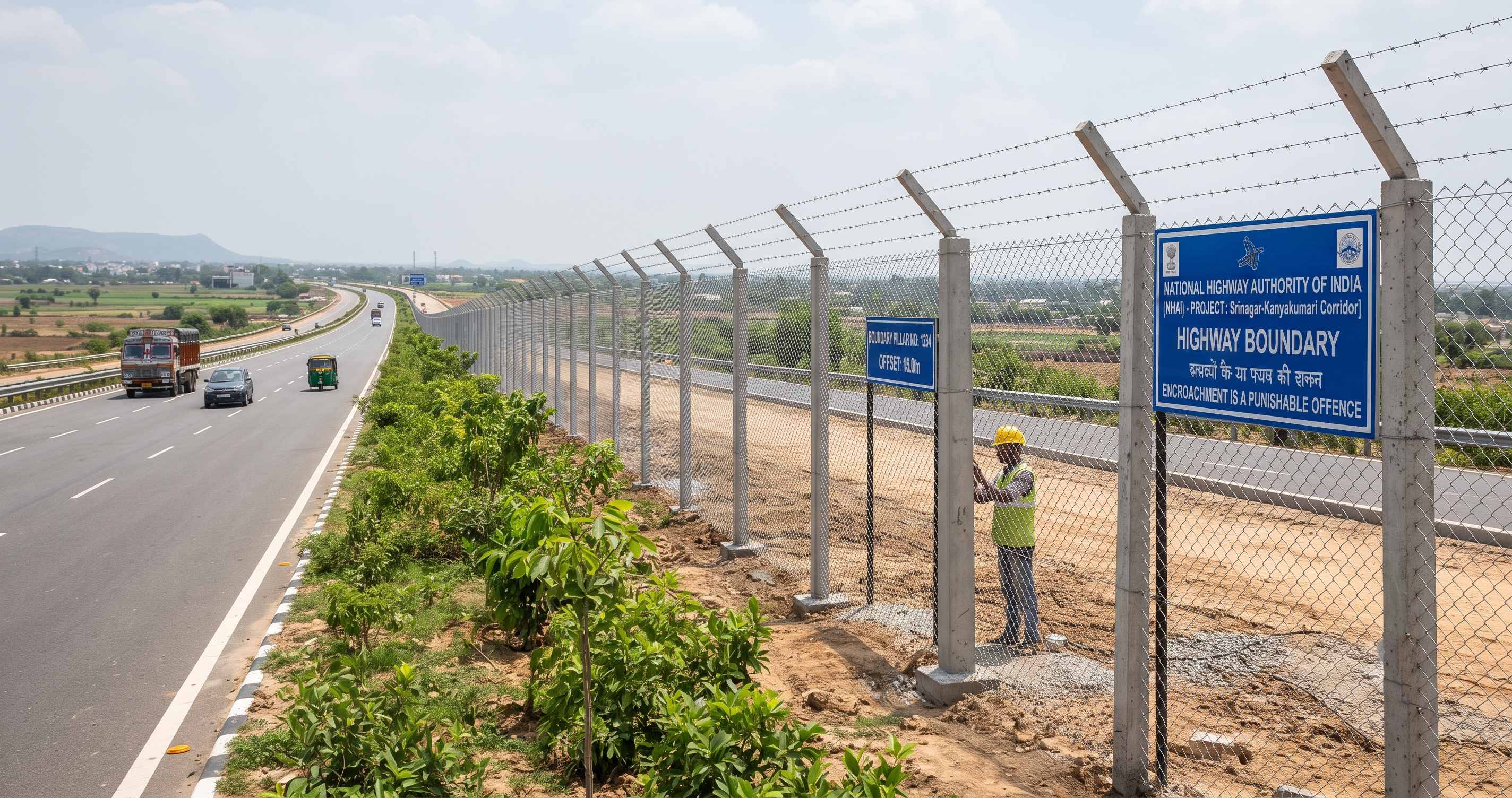
Highway Boundary Fencing Standards for National
Highway Projects in India
Highway boundary fencing standards exist to prevent one of the most overlooked failure points
on National Highway construction: an unprotected right-of-way. A National Highway corridor
without correctly specified boundary fencing isn't just a design gap, it's a liability waiting to
surface, whether through cattle intrusion, unauthorized encroachment, or a road safety incident
that traces directly back to a poorly fenced stretch. For civil engineers, infrastructure contractors,
and NHAI officials managing these projects, getting highway boundary fencing standards right
the first time avoids costly rework mid-construction and delays at handover. This guide walks
through what governs highway boundary fencing standards on National Highway projects in
India, from material selection to right-of-way compliance.
Why Highway Boundary Fencing Standards Matter on National Highway Projects
National Highway corridors run through a mix of agricultural land, forested stretches, and
populated areas, and each presents a different intrusion risk that highway boundary fencing
standards are designed to address. National Highway fencing guidelines across India are built
around a simple principle: the fence has to prevent unauthorized access, livestock movement,
and encroachment without obstructing drainage, maintenance access, or future widening plans.
Getting highway boundary fencing standards wrong has real consequences. Poorly specified
fencing on highway stretches is a recurring factor in cattle-related accidents, and inadequate
boundary protection has led to encroachment disputes that delay project handover well past the
contracted completion date.
India's National Highway network has expanded rapidly over the past decade, and boundary
fencing is now increasingly bundled into the same EPC or HAM contract as the carriageway
itself rather than tendered as a separate package. This shift places more responsibility on the
main contractor to interpret and apply the correct fencing type across every chainage, rather
than relying on a specialist sub-contractor working from an isolated scope.
NHAI Boundary Wall Specifications: What Contractors Need to Confirm
NHAI boundary wall specifications sit alongside broader highway boundary fencing standards
and typically define the fencing type by stretch classification, rural, semi-urban, or urban, since
risk profile and land use vary significantly along a single corridor. Contractors should confirm the
following before mobilizing fencing works on any NH package:
Fence type specified per chainage, chain link, welded mesh, or RCC compound wall
Height requirement, generally 1.8 to 2.4 meters depending on stretch classification
Post spacing and foundation depth suited to local soil conditions
Drainage cutouts or gaps required at culvert and embankment sections
Gate and access point locations for maintenance vehicles
Our welded wire mesh systems, manufactured in Grade 350 high-tensile steel with hot-dip
galvanizing, are commonly specified wherever highway boundary fencing standards call for a
rigid, low-maintenance boundary over long unmanned distances.
Road Safety Fencing Standards Along the Right-of-Way
Road safety fencing standards form a related but distinct part of highway boundary fencing
standards, since they address a different concern than pure boundary demarcation, preventing
the fence itself from becoming a hazard. Fencing along embankments, near medians, or close
to the carriageway edge has to avoid creating a rigid obstruction that increases injury severity in
a vehicle run-off scenario, which is why fence alignment is typically set back from the shoulder
edge per the project's geometric design.
Highway right-of-way protection also extends to preventing informal access points from forming
along the corridor. Continuous, well-anchored fencing without unauthorized gaps significantly
reduces both accident risk and unmonitored crossing points, particularly through populated or
semi-urban stretches where pedestrian shortcuts are common.
NH Fencing Construction Norms: Materials and Installation
NH fencing construction norms, closely tied to highway boundary fencing standards, generally
specify galvanized steel as the base material, given the multi-decade design life expected of
highway infrastructure. Chain link remains common on lower-risk rural stretches for its cost
efficiency, while welded mesh is increasingly specified on higher-traffic or encroachment-prone
sections for its added rigidity.
Our chain link fencing systems are supplied with PVC-coated and hot-dip galvanized finishes
suited to the extended outdoor exposure highway boundaries face, while our RCC compound
wall option is often specified for urban and semi-urban stretches where a permanent,
tamper-resistant barrier is preferred over wire mesh. Both material families are manufactured
under ISO 9001:2015 certified processes, which is increasingly a prerequisite for
prequalification on NHAI and state highway authority tenders, since it gives the client a verifiable
quality trail from raw steel coil to installed fence line.
Applying Highway Boundary Fencing Standards Across Different Terrain
Highway boundary fencing standards aren't uniform across an entire corridor, terrain and land
use dictate the specification stretch by stretch:
Rural and agricultural stretches: standard chain link or welded mesh, sized primarily to
prevent livestock intrusion
Forested or wildlife corridor sections: fencing coordinated with environmental clearance
conditions, often with wildlife crossing gaps
Urban and semi-urban stretches: RCC compound wall or heavy-gauge welded mesh,
prioritizing tamper resistance and encroachment prevention
Embankment and culvert zones: fencing with drainage cutouts to avoid obstructing
monsoon water flow
Toll plaza and interchange approaches: higher-visibility fencing coordinated with traffic
management design
For teams evaluating material trade-offs before finalizing a package, our guide on welded wiremesh specifications and grades covers gauge selection relevant to highway boundary fencing
standards on long highway runs.
Common Compliance Gaps Against Highway Boundary Fencing Standards
Even experienced contractors run into a handful of recurring issues when executing highway
boundary fencing standards on live NH projects:
Underspecifying corrosion protection for coastal or high-humidity stretches, leading to
premature rust
Missing drainage provisions at low-lying sections, causing waterlogging against the
fence line
Inconsistent post spacing across contractors on multi-package corridors, creating visible
quality gaps against agreed highway boundary fencing standards
Delayed material test certification, holding up quality audits during project handover
Using mismatched materials across adjoining contract packages, which creates a visible
seam where two contractors' work meets
Working with a manufacturer that supplies ISO 9001:2015 certified material with documentation
ready at dispatch helps contractors avoid the certification delays that commonly stall highway
project handovers and keep the project aligned with highway boundary fencing standards
throughout construction.
Frequently Asked Questions
What are highway boundary fencing standards based on?
They generally follow NHAI's project-specific specifications, adapted for stretch classification,
chain link, welded mesh, or RCC compound wall, height, and drainage requirements along the
right-of-way.
Why does fence type change across a single highway corridor?
Terrain, land use, and risk profile vary significantly along a corridor, so rural stretches typically
use cost-effective chain link while urban or encroachment-prone sections often require heavier
mesh or RCC walls under stricter highway boundary fencing standards.
How does highway fencing affect road safety?
Properly aligned fencing prevents livestock and pedestrian intrusion onto the carriageway, while
correct setback from the shoulder edge avoids the fence itself becoming a collision hazard.
What galvanizing is typically required for NH fencing?
Hot-dip galvanizing, often up to $275g/m^{2}$ zinc density, is commonly specified to withstand
decades of outdoor exposure without significant corrosion.
Do highway fencing projects require material test certificates?
Yes. NHAI and EPC contractors typically require mill test certificates confirming steel grade and
coating compliance, one of the documentation checks built into most highway boundary fencing
standards, before releasing payment milestones tied to fencing works. On larger corridor
projects, it's worth requesting these certificates in batches tied to delivery schedules rather than
waiting until the full quantity has been supplied, since this makes it far easier to trace a defect
back to a specific production lot if an issue surfaces during the defects liability period.
Executing highway boundary fencing standards on an NHAI or NH project? Arihant Fence is an
ISO 9001:2015 certified manufacturer of chain link, welded mesh, and RCC compound wall
systems, supplying highway and infrastructure projects across Maharashtra and India.
Arihant Steel, Agarwal Industrial Estate, Unit 1, Plot No.3, Sativali Kaman Road, Valiv, Vasai
East, Palghar District, Maharashtra 401208, India
+91 9322290173 | +91 8451902259
arihantsteel123@gmail.com
Request a Quote →